

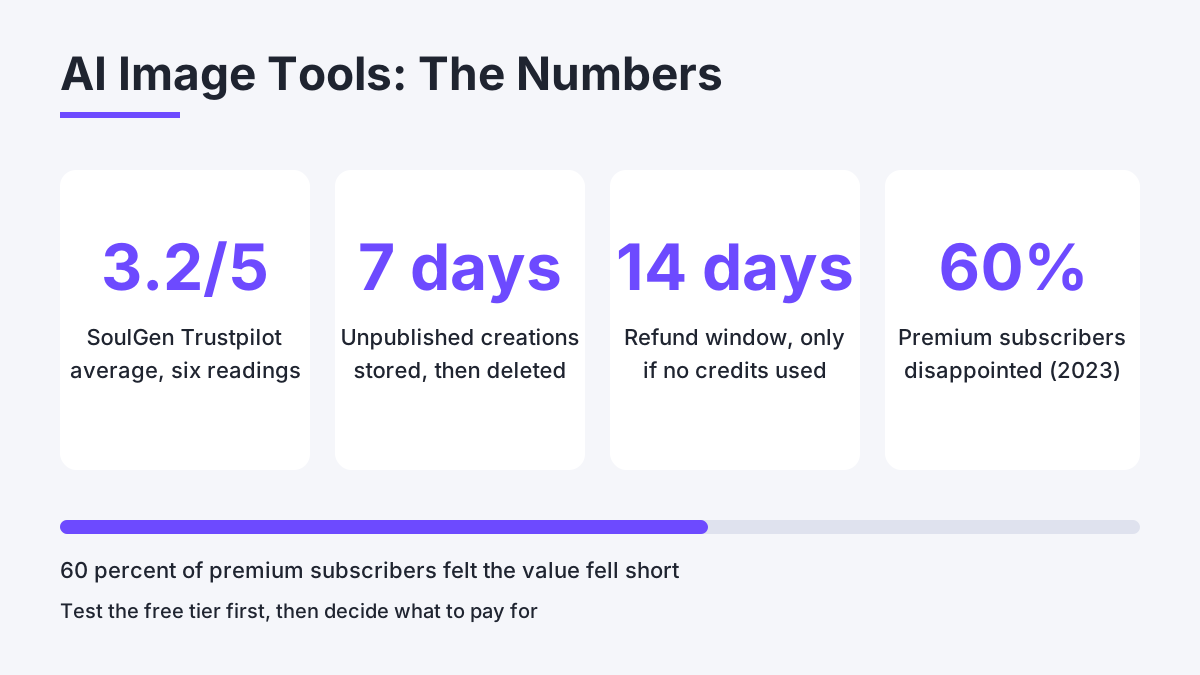
The best AI image generator for a UK user depends on three variables: what you want to make, what you will pay, and how much you trust the provider with your data. Midjourney, DALL-E, Stable Diffusion and SoulGen sit at different points on each. In our tracking since 31 August 2026, SoulGen's Trustpilot score has averaged 3.2 out of 5 across six readings, so no tool here is beyond criticism.
How We Compared Them
Most comparison pages rank tools by image quality alone. That misses what a UK buyer actually runs into after signing up. We looked at four things: output style, price model, data handling, and licence terms.
Output style matters because the tools are not interchangeable. Midjourney leans painterly and cinematic. DALL-E 3 sticks closely to the words you type. Stable Diffusion gives the most control but demands the most setup. SoulGen bundles text-to-image, image editing, outpainting, video generation and character chat on one platform, run by Synapse AI Limited in Hong Kong.
Price model is the second filter. Subscriptions, credit packs and free tiers behave differently once you generate more than a handful of images. Data handling comes third, and it is the one most reviews skip. The fourth, licensing, decides whether you can legally sell what you make.
Midjourney, DALL-E and Stable Diffusion in Practice
Midjourney remains the usual pick for illustrators and designers who want atmosphere without much prompt engineering. Its weakness is control. You steer it with prompt phrasing and parameters rather than precise instructions, and there is no meaningful free tier. Our SoulGen vs Midjourney comparison covers where the two overlap.
DALL-E is the easiest starting point. If you can describe a scene in plain English, it renders that scene with fewer surprises than its rivals. It handles text inside images better than most. The trade-off is a more cautious content filter, which rejects prompts that other tools accept. See SoulGen vs DALL-E for a closer look.
Stable Diffusion is open source, so you can run it on your own graphics card and pay nothing per image. That also means your prompts never leave your machine, a real privacy advantage. The cost is time: installing interfaces, downloading models and troubleshooting drivers. Anyone without a capable GPU will end up on a paid hosted service anyway. We set it against the alternatives in SoulGen vs Stable Diffusion.
Where SoulGen Fits
SoulGen is the odd one out because it is not only an image tool. Beyond text-to-image, it offers image editing through text prompts, AI outpainting to extend a picture, video generation from a still or a prompt, and Soul Chat for conversations with AI characters. If you only need one-off pictures, that breadth is wasted. If you want a character to appear in an image, then in a short talking video, then in a chat, one account handles all three.
The platform's own policy states that creations you do not publish to the community are stored for 7 days, then deleted automatically. That is good for privacy and bad if you forget to download. Published content stays until you remove it. Our full SoulGen review and the guide on how SoulGen works go through the credit system in more detail.
Payment runs through third-party processors, with credit card and PayPal listed. The company says it does not collect payment details itself. That is a reasonable design, though it also means billing disputes go through a middleman.
What a Paid Plan Really Costs You
Last July I tested a premium subscription at 29.99 GBP per month on a companion-style AI product. It promised unlimited messaging and custom personality settings. Two weeks in, the replies felt more scripted than on the free version, and I cancelled. I was not alone: a 2023 user survey by ai_girlfriendreview.com found that 60 percent of premium subscribers were disappointed with the value.
The lesson carries over to image tools. Unlimited is rarely unlimited, and a higher tier often adds volume rather than quality. Before you subscribe, generate a dozen images on the free tier and judge whether the output matches what you pay for. Skip any plan you cannot cancel in one click.
Refund terms deserve a read too. SoulGen offers refunds within 14 days, but only if you have not used any credits or images. Once you generate a single picture, the refund option is gone. That is a real limit, and it makes the free allowance more important than usual.
UK Law, Copyright and Privacy
Three legal points matter for UK users. First, UK GDPR, which sits alongside the Data Protection Act 2018, applies to any provider handling your personal data, including uploaded photos. Look for clear deletion rules and a stated retention period. Second, the Online Safety Act 2023 puts duties on platforms around harmful content, which is why filters differ so much between tools.
Third, copyright. The UK is unusual in giving some protection to computer-generated works under the Copyright, Designs and Patents Act 1988, though how that applies to AI output is still debated. In practice, your right to sell an image depends mostly on the provider's terms. SoulGen's terms say commercial use is allowed provided the content is lawful and does not infringe third-party rights. Never upload a real person's photo without their consent, and never generate content that copies a living artist's style for resale without checking the risk.
Where SoulGen sits with UK regulators is not stated in the material we have, so treat its compliance posture as something to check in its privacy policy rather than assume.
The Downsides to Weigh
No tool here is flawless, and SoulGen's weaknesses are specific. The free version is limited, and many features need credits. Content you do not publish disappears after 7 days. Refunds stop the moment any credit is spent. Its Trustpilot rating of around 3 out of 5 in our tracking is middling, with very few reviews behind it, so the sample is thin.
Midjourney's downsides are cost and the absence of a free trial. DALL-E's are stricter filters and less stylistic range. Stable Diffusion's are the technical hurdle and the need for decent hardware. Pick the weakness you can live with.
Which One to Pick
Choose Midjourney if polished artwork is the goal and you will pay for it. Choose DALL-E if you want literal prompt-following with minimal fuss. Choose Stable Diffusion if you have a GPU, patience, and a strong preference for keeping data local. Choose SoulGen if you want images, video and AI characters in one place and can live with the credit model and the 7-day storage window.
If your interest is character chat rather than imagery, our sister site Janitor AI covers that side of the market.
Comments
No comments yet.
Leave a comment
Your email will not be shown. Comments are reviewed before they appear.